All Content with tag 'Unity'
Asphalt Pave Simulator - Graduation Project
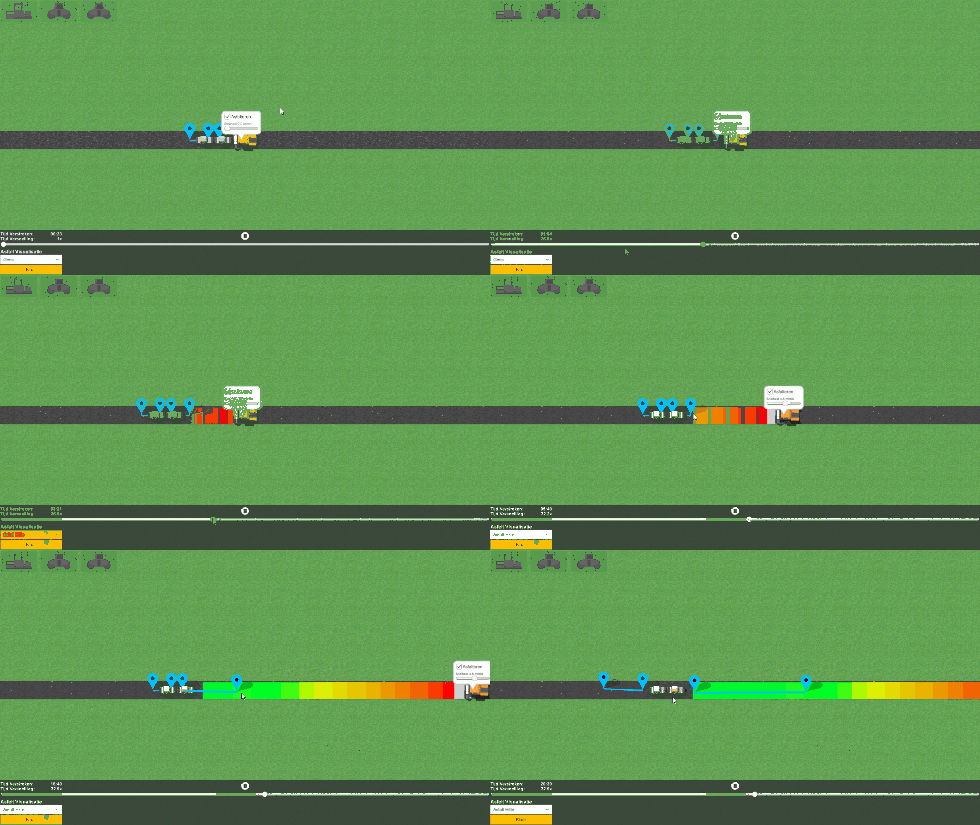
Asphalt Pave Simulator is a serious game created for asphalt road construction education. The goal of the serious game was to teach students the cause effect relationships between weather conditions and asphalt quality. This project was done as a graduation project for the University of Twente and was created by ASPARi, an asphalt road construction conglomerate.
The project had two goals:
- To educate students in a fun way, which environmental factors would influence the way compaction should be done during the process of asphalt road construction and
- to attract new students to the field of asphalt road construction. A secondary goal of the project was to familiarise students with new technologies which are developed for asphalt road constructions. These technologies include thermal imaging technology, geological tracking, real-time weather data and compaction sensors.
The game consists of three phases, a planning phase where the player/learner is presented with a scenario and is asked to input the parameters of the construction job; an execution phase, where the player/learner executes the plan, paves the asphalt and compacts the asphalt; and finally a feedback phase where the user gets feedback on his/her performance. This loop is repeated in every subsequent level.
The serious game was tested twice with students in asphalt road construction. Once at the SOMA college for construction and once at the ROC of Twente. Both tests resulted in a lack of perceived learning. This could be contributed to the fact that the target users which the game aims to teach were not able to test the game, therefore a group of students who already know the material which was tested. Another factor could be the game itself, as the game coped with some technical problems which could have influenced the game’s ability to teach. The fun factor for the game was probably also influenced by this, as stated by the testers.
The full report can be read here.
The Side Effects of Life in Space
Responsibilities
- Creation of dialogue creation system and tools
- Creation of the dialogue interpreter
- Implementation and design of the object interaction model
- Concept art
- Audio for walking and talking
- Save System
- Room connection system
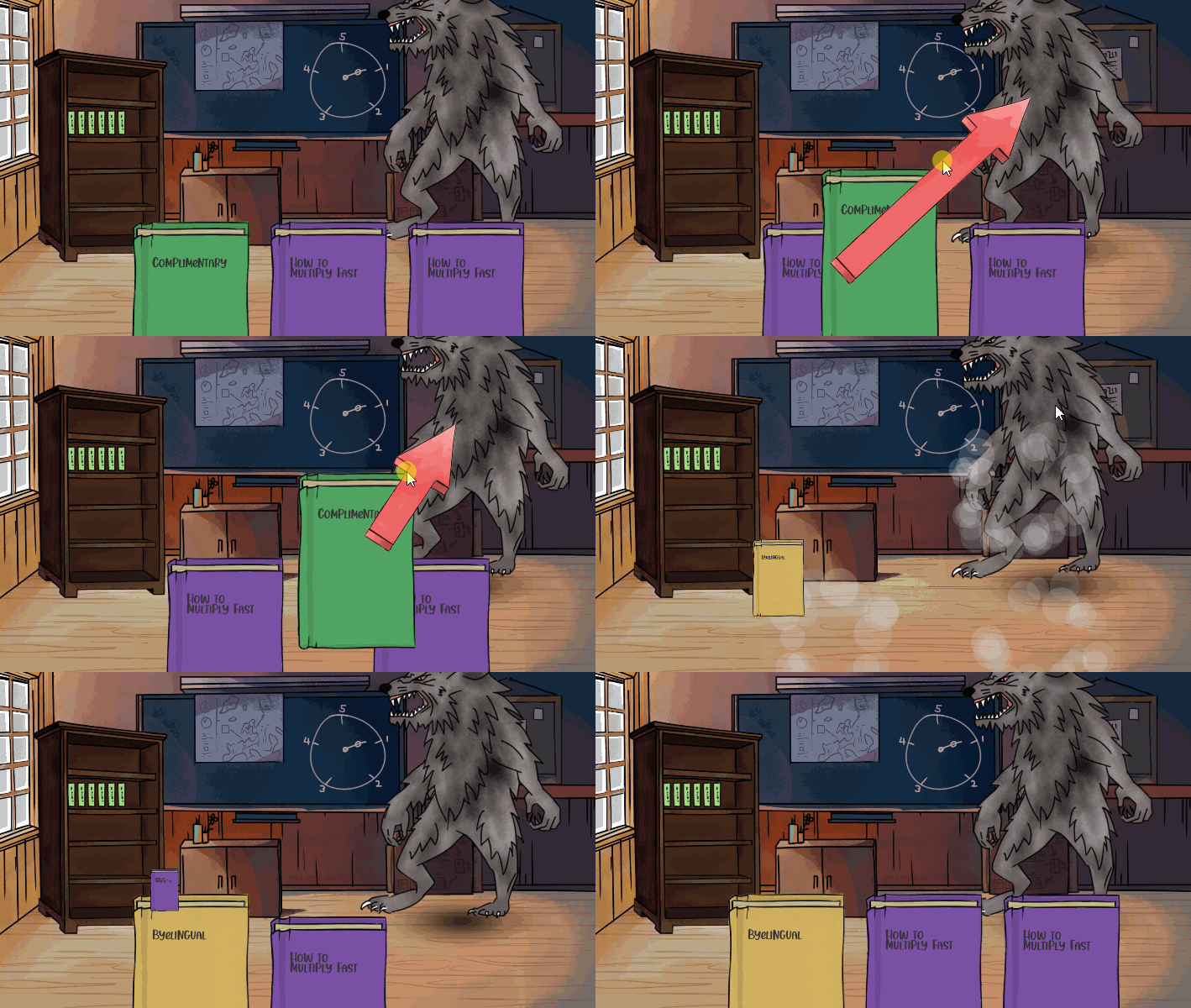
The Side Effects of Life in Space was a point-and-click adventure game developed by “Who is Noah Games?!” a collaboration between Gege Zhang, Ekki and me (Gege and Ekki are now called Mildly Entertaining Games). The game was about exploring the human condition on an interplanetary journey to colonize a planet. The player would play as a Psychologist with the task of keeping everyone mentally sane and happy campers during the months long journey.
My role during the project was to create the dialogue system and tools, develop the object interaction system and help with concept art.
Dialogue System
The dialogue system was created by using Unities Scriptable objects system. These scriptable objects were modeled as nodes in a graph which would be the conversation tree. Each node in the three would either be a text node for any of the conversation participants, a choice node for the player character, conditional nodes based on items or previously set markers, a marker node for setting markers or a transfer node of objects.
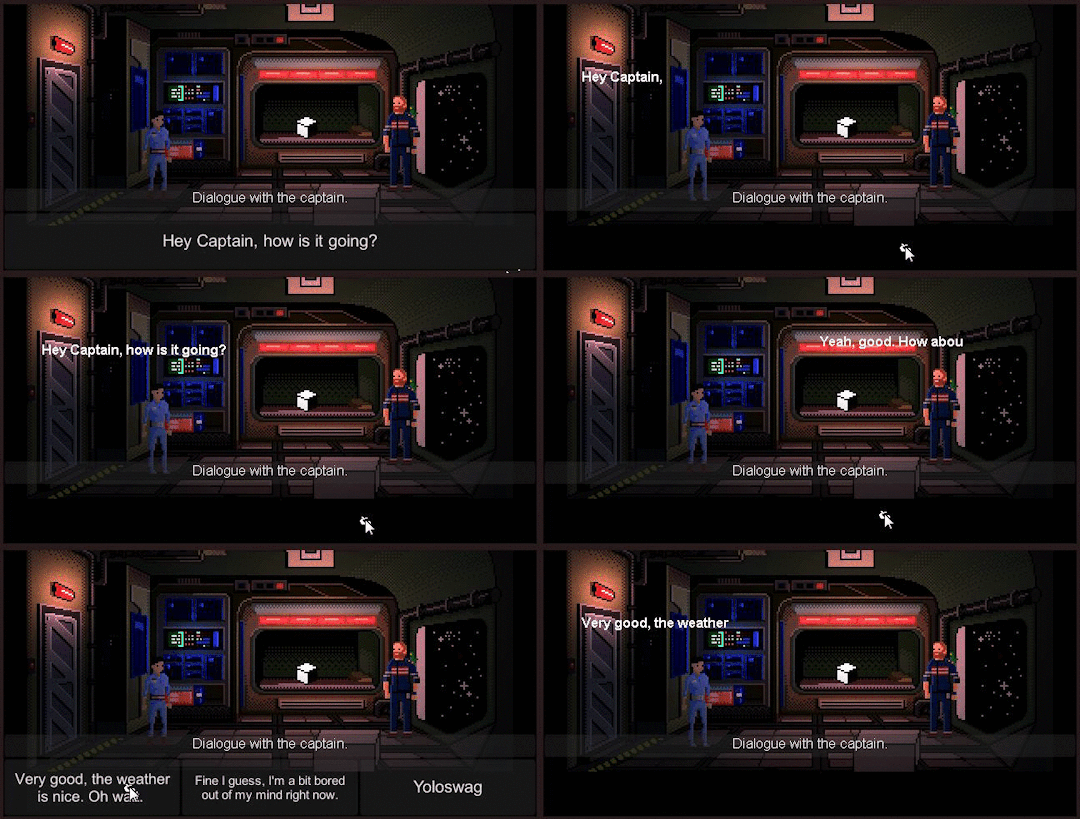
An editor was created for the dialogue writer and story creator to make the dialogues in. This dialogue can be seen in the image below. The nodes can be dragged and dropped and connections between nodes can be created by dragging the line towards the node.
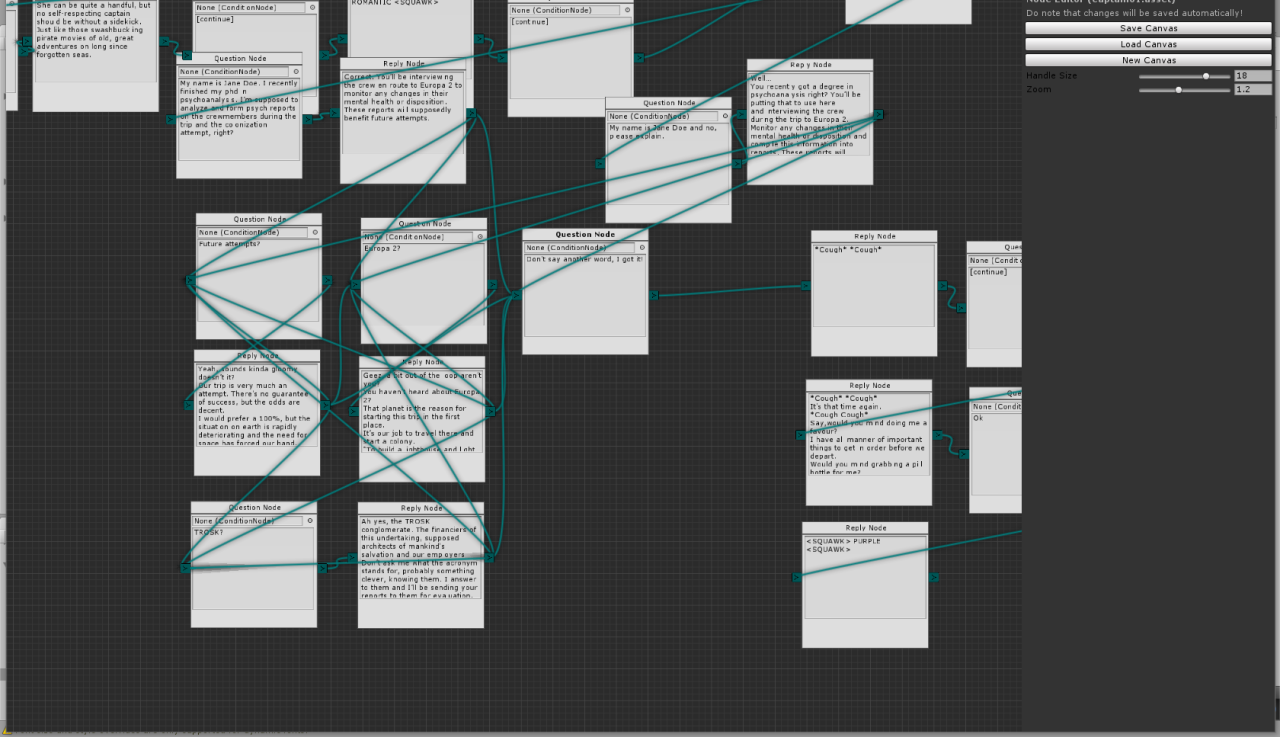
Read more about the dialogue system and editor here.
Space Trader (Ludum Dare 30)
For Ludum Dare 30 we wanted to do something special. So we created a game where we would connect two different worlds. These worlds would be hosted by different devices. One host screen and multiple clients. Inspired by the tablet design of the WII U but without the limitations of only having one tablet.
Cyber Defence (Ludum Dare 28)
A failed game about first person tower defense with weapons that you can only use once. The major reason why it failed was the difficulty curve design. It needed much more testing.
Achtung Die Kurve
For my student dorm, I created a clone of the Achtung die Kurve game in order to allow them to play on the couch with controllers a keyboard and even a mouse, which was not possible with other iterations of the same game. The game is sort of a combination between the older arcade game Tron and Snake, however, you are only allowed to move in curves. The curves also randomly break at certain intervals such that other players can move in between these sections. The game can be played with up to 6 others, but only if you have 4 gamepads, a mouse and a keyboard plugged into the same computer. The game is sectioned into rounds where the last player standing wins. The game becomes extremely chaotic and fun when you play with enough others.
Vectro Wars (MiniLD #58)
In March of 2015 I, together with Thomas Dijnum and Siewart van Wingerden participated in the 58th Mini Ludum Dare game jam. During this weekend long event, we created a game which was inspired by the game Pong (which was the theme of the game jam). During this game jam we created Vectro Wars where you need to defend your planet against incoming asteroids.
Colossus (7DFPS)
read moreSTL RNNR (Ludum Dare 26)
Run forever in an endless struggle to gain meters. Don't hesitate or look back, because the floor will disappear beneath your feet! Go, get your high score while you still can!
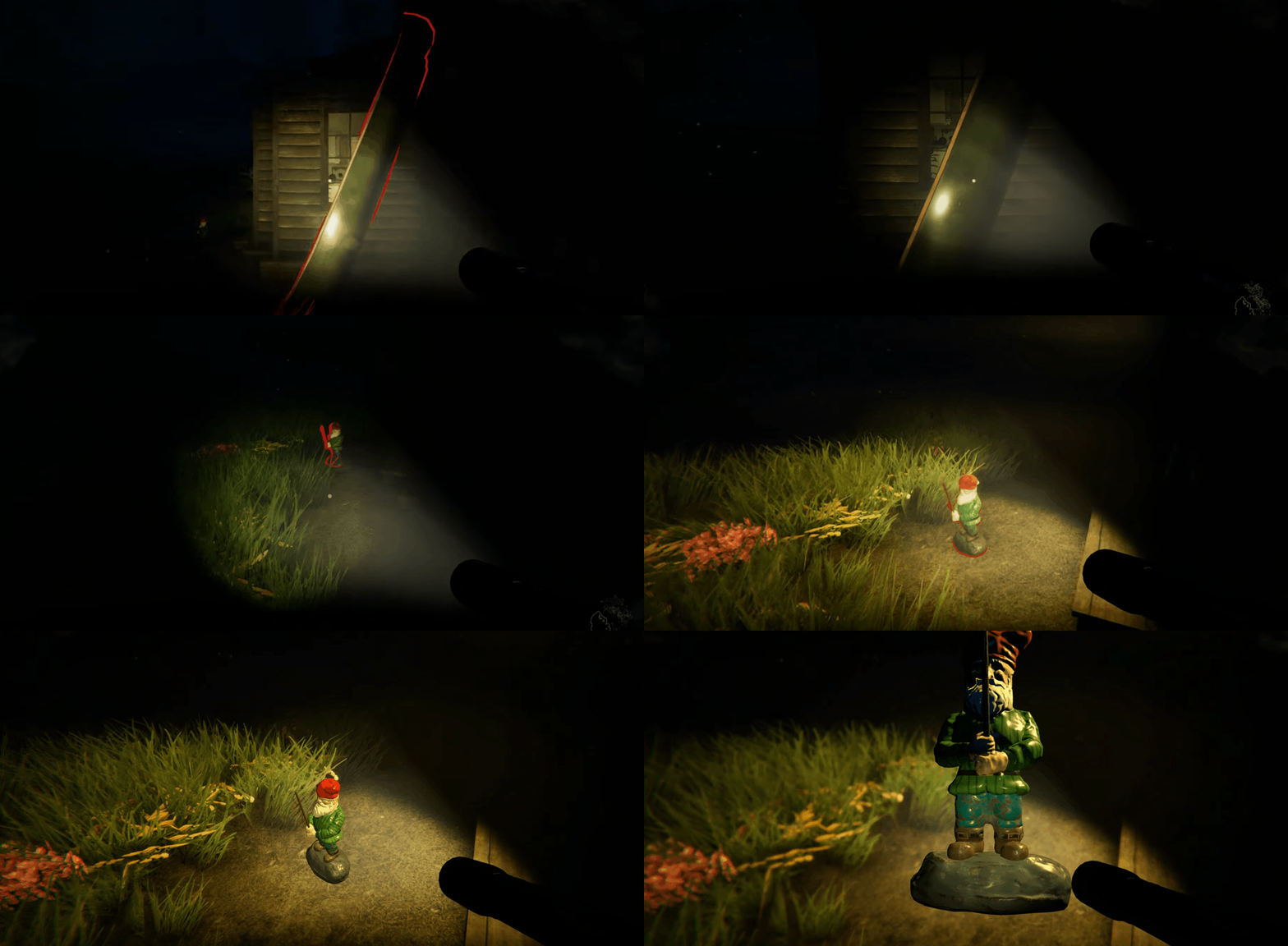 Outline effect as shipped in the game